Buying Guides
Silicone Steam Mats for Southeast Asia's Dim Sum and Food Service Market
Southeast Asia's frozen dumpling market reached US$185.6 million in 2025, per Cognitive Market Research. What chain kitchens check in perforated silicone steam mats, from hole size to FDA reports.
The Short Version
Southeast Asia's frozen dumpling trade grew from US$117.8 million in 2021 to US$185.6 million in 2025, and every one of those products passes through a steamer — so the liner under it decides whether a kitchen serves at speed or stalls on prep.
A perforated silicone steam mat answers three things a chain kitchen cannot compromise on: clean release without oil or paper, a surface that goes into the wash instead of the bin, and a food-contact file a procurement team can review. This guide covers the regional market, why the leaf-and-paper routine breaks at volume, and how to match a mat and its hole pattern to each dim sum line.
Southeast Asia's Dim Sum Volume Is Climbing Fast
Cognitive Market Research sizes the Southeast Asian frozen dumpling market at US$117.8 million in 2021 rising to US$185.6 million in 2025, and projects US$458.3 million by 2033. Frozen char siu bao in the same region follows a parallel curve, from US$10.645 million in 2021 to US$14.554 million in 2025.
The global figures show where that volume lands. Cognitive Market Research puts frozen dumplings worldwide at US$5.9218 billion in 2025, rising to US$13.3963 billion by 2033, with Asia-Pacific the largest and fastest-growing region; its global frozen char siu bao figure is US$347.6 million in 2025, more than two-thirds of it in Asia-Pacific. ResearchAndMarkets sizes the global frozen dim sum assortment category at US$4.88 billion in 2025, growing to US$7.11 billion by 2030, and lists foodservice demand for quick-preparation dim sum among the growth drivers.
Volume at that scale does not arrive as a statistic. It arrives as steamer baskets stacked six high at 6 a.m., a tray washer running behind them, and a prep list that must clear before the first order lands. That is when the liner stops being a detail.
Why the Traditional Liner Breaks at Chain Volume
The conventional methods are well documented and work at home scale. wikiHow's steamer guidance lines a bamboo basket with lettuce or cabbage leaves, or switches to steamer paper when the leaves are not on hand. Vicky Pham's har gow recipe brushes oil across the steamer floor or sets a small square of wax paper under each dumpling; her bánh bao method places proofed dough on a 2 × 2 inch parchment square or in a paper cupcake liner. Her bánh cuốn batter is poured onto a taut cloth and lifted off by hand, a step she notes depends on the cook's skill.
Read that list as a purchasing document and the pattern appears. Every line is a consumable: leaves by the crate, oil by the bottle, wax paper and parchment squares by the box, cupcake liners by the sleeve. Each is consumed at the pace of production, so the purchase order renews itself as long as the kitchen cooks — and the materials arrive with no specification attached: a cabbage leaf cannot produce a food-contact report, and neither can a wax paper square.
The labor is quiet but real. Paper squares are placed one dumpling at a time and cleared one at a time, the bánh cuốn cloth sets the station's pace to the steadiest pair of hands on the line, and release quality shifts with each batch of leaves. At a chain's daily volume that decides whether output is even, and whether the hygiene routine can be documented or merely described.
What a Perforated Silicone Steam Mat Changes
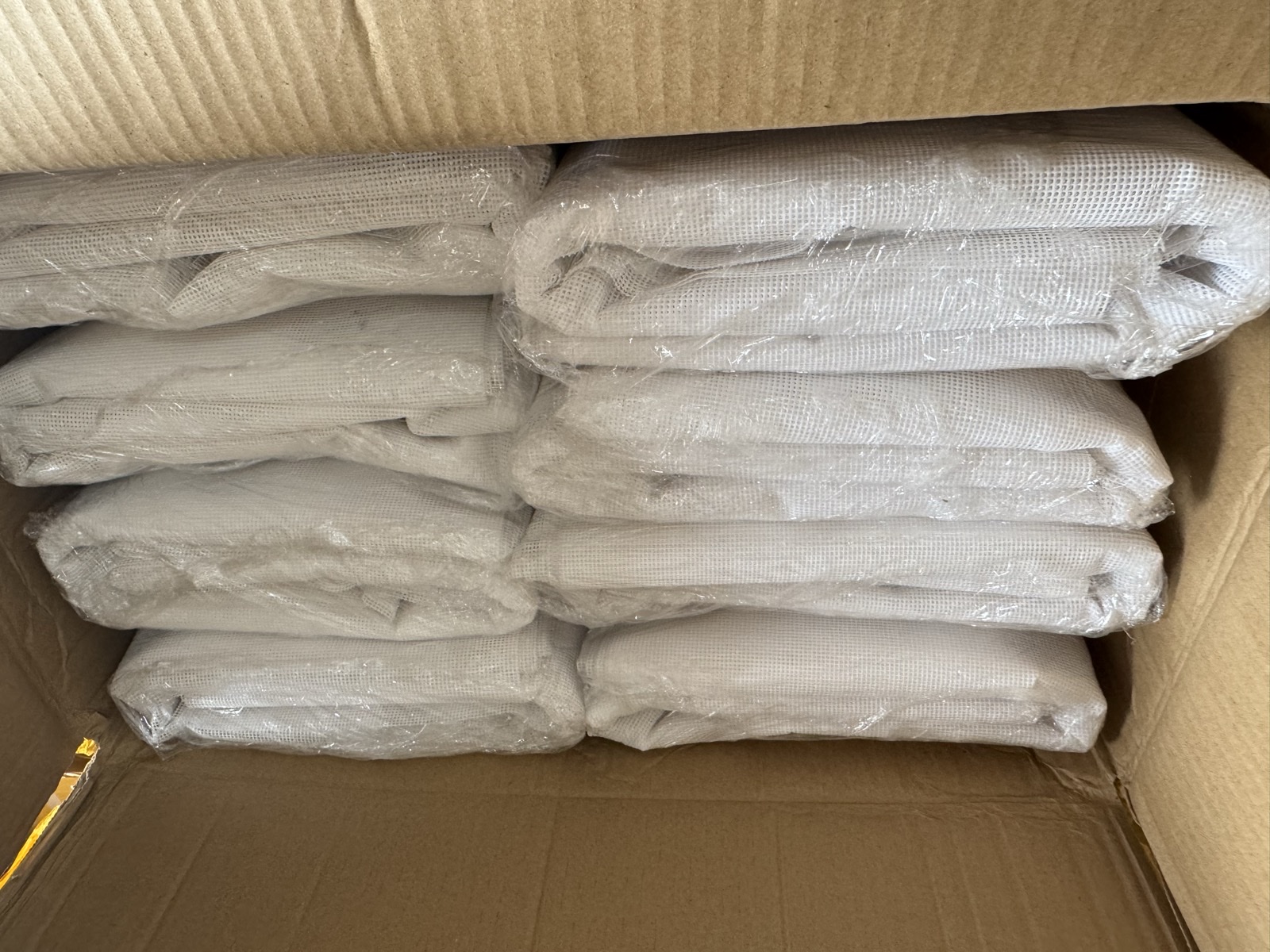
A perforated silicone steam mat replaces the improvised liner with one reusable surface. Food-grade silicone releases dumplings, bao and rice rolls without oil or paper, so the per-piece prep step disappears; the mat trims to the footprint of the baskets you already own; and at the end of service it goes into the washer rather than the bin.
Perforation is the specification that decides performance. PuraDry makes every mat perforated, in three hole patterns: 0.5 mm for small, delicate pieces such as har gow and soup dumplings, where a wider opening leaves the skin unsupported, so it sags, tears or takes on water; 1 × 1 mm as the general pattern for baozi, dumplings and most dim sum; and 4 × 4 mm where steam has to move hard through the basket, as with large buns and thicker doughs.
As the factory behind this guide, PuraDry manufactures in Shenzhen in 100 percent food-grade, BPA-free silicone rated from -40 °F to 356 °F (-40 to 180 °C). Standard sizes are 60 × 80, 70 × 90 and 80 × 90 cm, all 0.7 mm thick, with custom cuts to 2 m wide and 100 m long rolls. MOQ is 20 mats, 1,000 mats ship in 3-5 days, samples are free, and the FDA 21 CFR 177.2600 report is available on request.
What Chain Buyers in Singapore and Vietnam Check First
Chain buyers in Singapore and Vietnam evaluate a mat the way they evaluate a supplier. Batch consistency comes first: does mat number 400 release the same way as mat number 1, and does the perforation hold its tolerance across reorders. Cleaning comes second: can the mat take a commercial wash cycle, a sanitizer and a stacked tray rack without curling at the edges.
Documentation settles more purchases than price does: a central kitchen's quality team needs to know what touched the food and be able to show it, so the material report is requested during sampling rather than after the purchase order. The three questions below are the ones buyers ask us most often.
Frequently Asked Questions
Will these mats fit the steamers we already own?
Standard sizes cover the common commercial baskets, and mats trim to a custom footprint, so most kitchens fit existing equipment without replacing it. Free samples ship in 60 × 80, 70 × 90 and 80 × 90 cm at 0.7 mm thick, or cut to size.
How long does a mat last in daily food-service use?
Silicone mats are specified as reusable, machine washable, non-stick and heat resistant, and service life on a commercial line depends on three variables: wash chemistry, handling and stacking, and steam cycles per shift. Because those vary by kitchen, the answer comes from a trial — run free samples through your own wash and steam routine for a week and check release quality before committing to volume.
What documentation can we review before ordering?
The FDA 21 CFR 177.2600 report for PuraDry's food-grade silicone is available on request and can travel with samples. In chain procurement a food-contact test report is the first thing a chain buyer asks for, so it is worth having your basket sizes, product families and expected volumes ready before the first call.
What This Means for Buyers
Southeast Asia's frozen dumpling market heads toward US$458.3 million by 2033 on Cognitive Market Research's projection, and the kitchens serving it are choosing now which liner to scale with. Write down your basket sizes, pick a hole pattern per product family, and request free samples with the FDA 21 CFR 177.2600 report through the contact page. With an MOQ of 20 mats and a 3-5 day lead time on 1,000 mats, one test shift settles the specification.